

BMS Temperature Sensors
BMS temperature sensors are used throughout Building Management Systems (BMS) and HVAC installations to measure temperature and allow the control system to monitor and regulate heating, cooling and ventilation equipment.
How they work
A temperature sensor measures the temperature of air, water, pipework or another medium and provides a signal to the BMS controller. The controller converts that signal into a temperature value, such as 21.5°C, which can then be displayed, logged or used within control logic.
Common sensor types include NTC thermistors, PT100, PT1000, and active transmitters providing 0–10 V or 4–20 mA signals.
Common BMS temperature sensors
| Sensor | Typical application |
|---|---|
| Room sensor | Measures room/space temperature |
| Duct sensor | Supply, extract, return and outside-air ducts |
| Immersion sensor | Heating and chilled-water pipework using a pocket |
| Strap-on sensor | Measures pipe surface temperature |
| Outside-air sensor | External temperature measurement |
| Frost sensor | Protects coils and equipment from freezing |
| Average temperature sensor | Measures temperature across a larger duct or coil |
| Remote probe sensor | Refrigeration, plant and specialist applications |
Passive vs active sensors
Passive sensors change their electrical resistance according to temperature. The BMS controller measures the resistance and converts it to °C. Common examples are 10K3A1, 10K4A1, 20K NTC, PT100 and PT1000.
Active sensors/transmitters contain electronics that convert the temperature measurement into a standard signal, commonly 0–10 V or 4–20 mA. These are particularly useful where longer cable runs or standardised analogue signals are required.
Example – 10K3A1
A 10K3A1 thermistor has a nominal resistance of approximately 10,000 Ω at 25°C.
As an NTC sensor:
Temperature rises → resistance falls
Temperature falls → resistance rises
The BMS uses the appropriate resistance/temperature curve to calculate the actual temperature.
Why temperature sensors matter
Accurate sensing allows a BMS to control boilers, chillers, AHUs, pumps, valves, heating circuits, fan coils and ventilation systems. The readings can also be used for alarms, frost protection, energy optimisation, trend logging and fault diagnosis.
One important point when replacing a BMS sensor is that physical appearance isn’t enough. The replacement must have the correct sensing characteristic—such as 10K3A1, PT1000 or 4–20 mA—and the BMS input must be configured for that same signal type.
The specification of a 10K3A1 temperature sensor
A 10K3A1 temperature sensor is a 10 kΩ NTC thermistor commonly used in HVAC/BMS applications. The designation generally refers to the 10K Type 3 / 3A1 thermistor curve.
| Specification | 10K3A1 |
|---|---|
| Sensor type | NTC thermistor |
| Nominal resistance | 10,000 Ω at 25°C (77°F) |
| Resistance characteristic | Resistance decreases as temperature increases |
| Nominal Beta (β) value | ≈ 3976 K |
| Common designation | 10K Type 3 / 10K3A1 |
| Reference temperature | 25°C |
| Typical operating range | Approximately −40°C to +125°C, depending on sensor construction |
| Typical accuracy | Usually ±0.2°C to ±0.5°C around normal HVAC temperatures, depending on the manufacturer |
| BMS input | Passive resistive / thermistor input |
| Polarity | None |
Typical 10K3A1 resistance values
Approximate values useful for BMS commissioning and fault finding are:
| Temperature | Approx. Resistance |
|---|---|
| −20°C | 96.8 kΩ |
| −10°C | 55.3 kΩ |
| 0°C | 32.6 kΩ |
| 5°C | 25.4 kΩ |
| 10°C | 19.9 kΩ |
| 15°C | 15.7 kΩ |
| 20°C | 12.5 kΩ |
| 25°C | 10.0 kΩ |
| 30°C | 8.06 kΩ |
| 35°C | 6.53 kΩ |
| 40°C | 5.33 kΩ |
| 50°C | 3.60 kΩ |
| 60°C | 2.49 kΩ |
| 70°C | 1.76 kΩ |
| 80°C | 1.27 kΩ |
| 90°C | 0.93 kΩ |
| 100°C | 0.70 kΩ |
For Tridium Niagara N4
For an N4 controller/input configured for a 10K3A1 thermistor, the important characteristics are:
R25 = 10,000 Ω
Beta ≈ 3976 K
One important point: 10K thermistors are not interchangeable just because they all measure 10 kΩ at 25°C. A 10K Type 2, Type 3/3A1 and other 10K curves can produce significantly different temperatures away from 25°C. For a BMS specification, I would therefore specify “10 kΩ NTC, Type 3/3A1 characteristic, R25 = 10 kΩ” rather than simply “10K thermistor.”
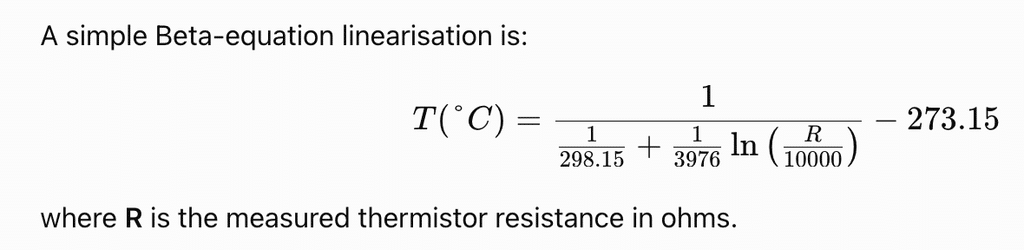
Below is the full 10K3A1 resistance/temperature table from −40°C to +120°C in 1°C increments, calculated using:

| Temp °C | Resistance Ω | Temp °C | Resistance Ω |
|---|---|---|---|
| -40 | 411,749 | 41 | 5,070 |
| -39 | 382,827 | 42 | 4,871 |
| -38 | 356,157 | 43 | 4,680 |
| -37 | 331,548 | 44 | 4,498 |
| -36 | 308,825 | 45 | 4,324 |
| -35 | 287,832 | 46 | 4,158 |
| -34 | 268,423 | 47 | 4,000 |
| -33 | 250,469 | 48 | 3,848 |
| -32 | 233,850 | 49 | 3,703 |
| -31 | 218,457 | 50 | 3,564 |
| -30 | 204,192 | 51 | 3,431 |
| -29 | 190,964 | 52 | 3,304 |
| -28 | 178,691 | 53 | 3,183 |
| -27 | 167,297 | 54 | 3,066 |
| -26 | 156,712 | 55 | 2,955 |
| -25 | 146,875 | 56 | 2,848 |
| -24 | 137,727 | 57 | 2,746 |
| -23 | 129,215 | 58 | 2,648 |
| -22 | 121,291 | 59 | 2,554 |
| -21 | 113,910 | 60 | 2,463 |
| -20 | 107,031 | 61 | 2,377 |
| -19 | 100,617 | 62 | 2,294 |
| -18 | 94,633 | 63 | 2,215 |
| -17 | 89,048 | 64 | 2,138 |
| -16 | 83,831 | 65 | 2,065 |
| -15 | 78,958 | 66 | 1,995 |
| -14 | 74,402 | 67 | 1,927 |
| -13 | 70,141 | 68 | 1,862 |
| -12 | 66,154 | 69 | 1,800 |
| -11 | 62,421 | 70 | 1,740 |
| -10 | 58,925 | 71 | 1,682 |
| -9 | 55,649 | 72 | 1,627 |
| -8 | 52,578 | 73 | 1,574 |
| -7 | 49,698 | 74 | 1,522 |
| -6 | 46,995 | 75 | 1,473 |
| -5 | 44,458 | 76 | 1,426 |
| -4 | 42,075 | 77 | 1,380 |
| -3 | 39,836 | 78 | 1,336 |
| -2 | 37,731 | 79 | 1,294 |
| -1 | 35,752 | 80 | 1,253 |
| 0 | 33,890 | 81 | 1,214 |
| 1 | 32,138 | 82 | 1,176 |
| 2 | 30,487 | 83 | 1,140 |
| 3 | 28,933 | 84 | 1,105 |
| 4 | 27,468 | 85 | 1,071 |
| 5 | 26,088 | 86 | 1,038 |
| 6 | 24,785 | 87 | 1,007 |
| 7 | 23,557 | 88 | 977 |
| 8 | 22,397 | 89 | 947 |
| 9 | 21,302 | 90 | 919 |
| 10 | 20,268 | 91 | 892 |
| 11 | 19,291 | 92 | 866 |
| 12 | 18,367 | 93 | 840 |
| 13 | 17,493 | 94 | 816 |
| 14 | 16,667 | 95 | 792 |
| 15 | 15,885 | 96 | 769 |
| 16 | 15,145 | 97 | 747 |
| 17 | 14,444 | 98 | 726 |
| 18 | 13,780 | 99 | 705 |
| 19 | 13,151 | 100 | 685 |
| 20 | 12,554 | 101 | 666 |
| 21 | 11,988 | 102 | 648 |
| 22 | 11,452 | 103 | 630 |
| 23 | 10,942 | 104 | 612 |
| 24 | 10,459 | 105 | 595 |
| 25 | 10,000 | 106 | 579 |
| 26 | 9,564 | 107 | 563 |
| 27 | 9,150 | 108 | 548 |
| 28 | 8,756 | 109 | 533 |
| 29 | 8,382 | 110 | 519 |
| 30 | 8,026 | 111 | 505 |
| 31 | 7,687 | 112 | 492 |
| 32 | 7,365 | 113 | 479 |
| 33 | 7,058 | 114 | 466 |
| 34 | 6,765 | 115 | 454 |
| 35 | 6,487 | 116 | 442 |
| 36 | 6,222 | 117 | 431 |
| 37 | 5,969 | 118 | 420 |
| 38 | 5,728 | 119 | 409 |
| 39 | 5,499 | 120 | 399 |
| 40 | 5,279 |
For Niagara N4 / BMS commissioning, some useful checkpoints from this calculated curve are:
0°C = 33.89 kΩ
10°C = 20.27 kΩ
20°C = 12.55 kΩ
25°C = 10.00 kΩ
30°C = 8.03 kΩ
40°C = 5.28 kΩ
50°C = 3.56 kΩ
60°C = 2.46 kΩ
70°C = 1.74 kΩ
80°C = 1.25 kΩ
90°C = 919 Ω
100°C = 685 Ω
One caution: this is a Beta-equation calculation using β = 3976 K. A manufacturer’s official 10K3A1 thermistor curve may use Steinhart-Hart coefficients or a resistance lookup table, so small differences are possible, especially at the extremes of the temperature range.