The Coefficient of Performance (COP) is a key measure of efficiency for heating and cooling systems. These include heat pumps, air conditioners, and refrigerators. It tells you how much heating or cooling you get per unit of energy consumed.
Definition
-
For heating:
COP = (Heat delivered to the building) ÷ (Electric power consumed) -
For cooling:
COP = (Heat removed from the building) ÷ (Electric power consumed)

COP = 4/1 = 4
That means it’s 400% efficient — every 1 kW of electricity provides 4 kW of heating energy.
Typical COP Values
| System Type | Typical COP (Heating Mode) | Notes |
|---|---|---|
| Electric resistance heater | 1.0 | 100% efficient (1:1) |
| Air-source heat pump | 2.0 – 4.0 | Depends on outdoor temperature |
| Geothermal (ground-source) heat pump | 3.5 – 6.0 | More stable due to constant ground temperature |
| Chiller / Air conditioner (cooling mode) | 2.0 – 5.0 | Higher COP = more efficient cooling |
Temperature Effect
-
For heat pumps:
-
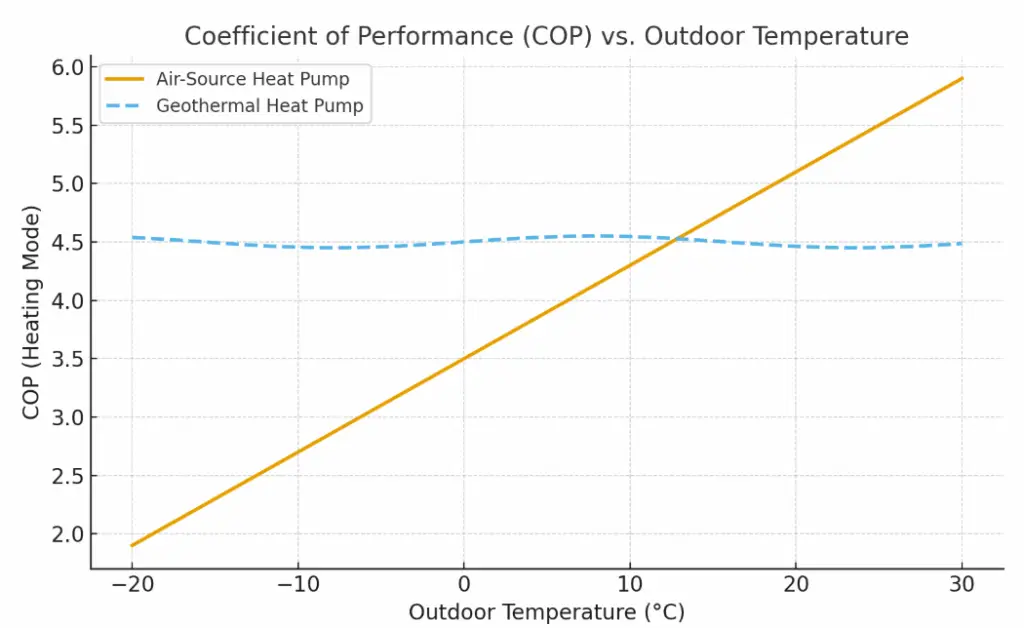
COP drops as outdoor air temperature decreases (less heat available).
-
COP rises as the temperature difference between inside and outside decreases.
-
-
For geothermal systems:
-
Ground temperature remains stable (10–16 °C or 50–60 °F), so the COP stays consistent throughout the year.
-
Relation to Other Metrics
-
In cooling applications (like air conditioners):
EER = 3.412 × COP
(EER = Energy Efficiency Ratio, in Btu/W·h)
-
In seasonal terms:
-
HSPF (Heating Seasonal Performance Factor) and SEER (Seasonal Energy Efficiency Ratio) are seasonal averages that roughly correspond to COP values over varying outdoor conditions.
-
In Summary
| Aspect | High COP | Low COP |
|---|---|---|
| Energy efficiency | High | Low |
| Operating cost | Lower | Higher |
| Environmental impact | Lower emissions | Higher emissions |
| Example system | Geothermal heat pump | Resistance heater |
Here’s the graph showing how the Coefficient of Performance (COP) varies with outdoor temperature:
-
The air-source heat pump (solid line) becomes less efficient as the outdoor temperature drops, because there’s less heat energy available in the air.
-
The geothermal heat pump (dashed line) maintains a nearly constant COP, since it exchanges heat with the ground, which stays at a stable temperature year-round.